Merrylegs
Black BeautyMerrylegs is a gray pony at Birtwick Park, valued as a companion and a mount for the household’s children. His account combines sociability with judgment: he carries young riders gently, but resists boys who ignore his fatigue and use their sticks against him. When the Gordon household disperses, he is given to the vicar under explicit conditions intended to secure his care beyond his working life.
Identity and Place at Birtwick Park
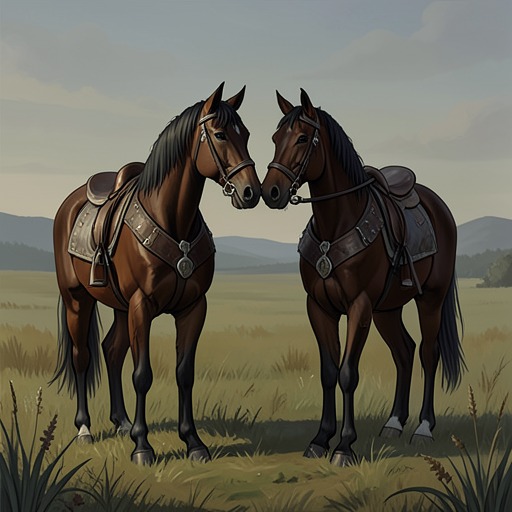
Merrylegs is introduced to Black Beauty as the pony in the neighboring stall. He is small and fat, with a thick mane and tail, a pretty head, and a pert nose. His own description of his place in the household is cheerful and self-assured: he carries the young ladies and sometimes takes their mistress out in a low chair, and he understands that the family and James value him. He is also alert to the prospect of a new neighbor, hoping that Black Beauty will be good-tempered and will not bite. The exchange establishes him as sociable and talkative, but also as a pony with preferences of his own.
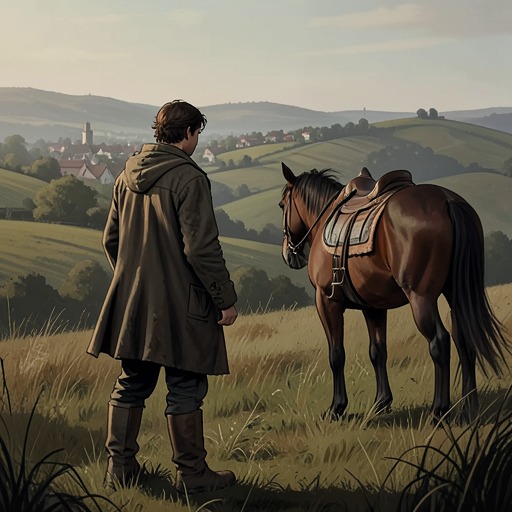
His identity is shaped by a stable household role rather than by a single owner’s use. Children visit from the vicar’s large family, and Merrylegs becomes the mount for their turns riding in the orchard and home paddock. He is familiar enough to be part of their ordinary recreation, and that familiarity carries responsibility: the children depend on him to adjust his pace to their confidence and ability.
Careful Work with Children
Merrylegs distinguishes the younger girls from the boys not by rejecting children as riders, but by describing how he responds to their needs. When Miss Jessie, Flora, or the smaller children are frightened or unsteady, he moves smoothly and quietly. Once they are comfortable, he goes faster to help them grow accustomed to riding. He presents this as deliberate instruction, not merely obedience; he considers himself both their friend and their riding teacher.
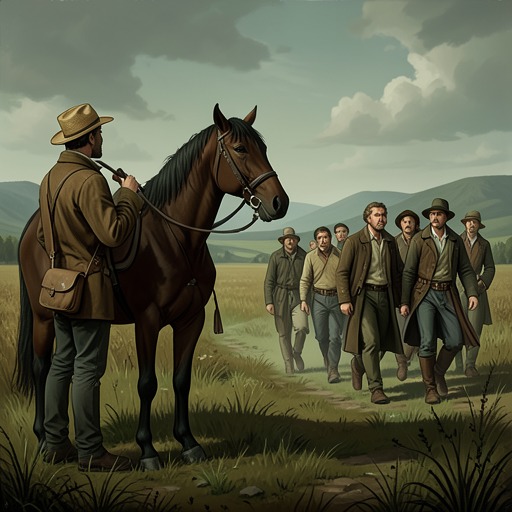
The episode with the older boys exposes the limits of that accommodating role. After the girls and younger children have ridden for a long time, the boys take their turn and ride him around the fields and orchard. They carry hazel sticks as makeshift whips and use them too forcefully. Merrylegs first stops several times, giving them a chance to understand that he has had enough. When they continue, he rises onto his hind legs and lets each boy slip off in turn. The action is directed at stopping their treatment of him, not at the children who have ridden carefully.
Merrylegs explains the contrast through the boys’ failure to recognize a pony’s fatigue and feelings: they act as though an animal can keep going like a machine. He does not describe them as malicious, and says he likes them; his objection is that they need to learn. James also objects to the large sticks, which he regards as unsuitable for young gentlemen. The episode gives Merrylegs a distinct form of agency: he uses restraint while it is respected, then makes his limit unmistakable when it is not.
Temperament and the Birtwick Household
The account presents Merrylegs as self-possessed rather than simply mild. He is pleased to be admired and trusted, and his account of his work is lively, yet he can distinguish a nervous young rider from a rough one. His conduct makes gentleness active: it involves reading the rider, moderating his pace, and preserving his own capacity to continue. His resistance to the boys complicates any assumption that a good-tempered pony should submit to every demand.
This conduct belongs within a household that the narrator describes as kind toward animals as well as people. At Birtwick, cruelty to any creature is not treated as a private matter to be ignored, and servants are said to follow the household’s example. Merrylegs’s episode makes that principle concrete on a small scale: he gives the boys repeated indications that he is tired, while the adults’ response condemns the use of the sticks. His experience also echoes the book’s broader concern with recognizing animal feeling, but remains specific to his role as a patient, capable pony whose limits deserve notice.
Departure and Prospects
When the mistress’s illness requires the family to leave England and the household is broken up, Merrylegs’s future is decided alongside the other horses’. The first members of the family to depart, Miss Jessie and Flora, come to say goodbye and embrace him as an old friend. Their farewell confirms that he is more than a convenient mount: he is an established companion in the children’s lives.
The master gives Merrylegs to the vicar, who needs a pony for Mrs. Blomefield, on the condition that he must never be sold. The arrangement also specifies that when Merrylegs is past work, he is to be shot and buried. Joe Green is engaged to look after him and help in the house, and the narrator concludes that Merrylegs is well provided for. The terms promise continuity of care and prevent him from being passed into another owner’s hands, while also defining an explicit end-of-working-life provision. The narrative does not report what later happens to him; his final appearance is therefore not a completed account of his old age, but a carefully arranged prospect of security after the break-up of Birtwick Park.